Showing posts with label pollination. Show all posts

Sunday, July 7, 2013

Lesson Plan- Berries and Pollination

Nature School
August 29th, 2011

Welcome song

Letter of the Day- B. For berries, birds, beautiful, bee, buzz,

Today we are going to be learning about berries and pollination.

Pollination
Who remembers this word- Pollination?

What is pollination? Pollination is what happens when a flower turns into a seed, or a berry, or a fruit. The flower is beautiful and attractive and smells wonderful. Little insects come and get nectar from the flower. When they land on the flower, they get a little bit of pollen on them. Then they spread that pollen to the next flower they go to. That is exactly what the flower wants to have happen!!! Spreading pollen from one flower to the next is great!! Then the seed begins to grow.

We, humans, love to eat the seeds, berries, or fruit that come from the flowers of plants after they are pollinated. Do you want to see some seeds of some plants we eat? Can you guess what plant they come from?

Senses Walk
Use a bandana or scarf to blindfold your budding naturalists and then carefully guide them through the park on a hike. Encourage them to use their other senses to experience the trip. Guide them towards trees and have them touch the bark, leaves and branches. What do they feel like? Have them stand still and listen. What sounds can they identify? What do they smell? Now switch places and let your child guide you!

Nature Scavenger Hunt
Hand out papers and pens

Nature collection and berry picking
We are going to pick some berries while on our hike today. With those berries, we will make a special ink that pioneers used long ago. Blackberry juice was used to dye cloth navy blue and indigo.

So, i want you to collect some different things in your bag. Berries, of course! I also want you to look for natural materials that you can use as a paintbrush- leaves, grass, sticks, stems, dandelions and other flowers, evergreen twigs, etc. Be creative! Put them in your bag and we will use them when we are done with our hike.

Pioneer Craft:
Homemade Ink from Berries
True ink could be very expensive so many pioneers had to make their own. Inks were made at home from many different ingredients depending on what color was needed or wanted.

According to different sources, they used berries, powdered roots, nuts, and even chimney soot.

Ingredients:
1/2 cup of ripe berries (blueberries, cherries, blackberries, strawberries, elderberries, raspberries, etc.
1/2 teaspoon vinegar
1/2 teaspoon salt

Tools:
measuring cups and spoon
strainer
bowl
wooden spoon

Directions:
1. Fill the strainer with the berries and hold it over a bowl.
2. Using the rounded back of a wooden spoon, crush the berries against the strainer so that the berry juice strains into the bowl.
3. Keep adding berries until most of their juice has been strained out and only pulp remains.
4. Add the salt and vinegar to the berry juice. The vinegar helps the ink to retain its color and the salt keeps it from getting moldy.
5. If the berry ink is too thick, a tablespoon of water.

Craft:
Use the ink and the natural paintbrushes the children collected to paint a picture. Let the children incorporate natural materials into their picture using glue and scissors.


Sunday, April 29, 2012

Lesson Plan- Flowers

Nature School
April 30th, 2012
Flowers


Welcome to Nature School today! Let’s sing our welcome song-

Letter of the Day:
Today we are going to be learning about flowers and pollination so our letter of the day is P for pollination. What other words do you know that start with P? Do any of our nature kids’ names start with P?

Who has seen some flowers blooming lately? There are lots of them, aren’t there? I’ve seen flowers on bushes, trees, and growing straight out of the ground!

Role Play:
Let’s pretend to be a flower. Let’s pretend our feet are roots. Plant them down in the dirt! Then stand up straight and tall. Your legs and your middle are the stem of the flower. Now, our arms and hands are our leaves. They help us photosynthesis and soak up sunlight. Now reach your neck up high and face the sun. That beautiful face of yours in the flower with its petals and beautiful bright colors. Oh, the sun feels so nice! Now it’s raining! We love the rain because it gives us a nice drink which we need to survive. Let’s slurp up some water with our roots. SLURP!! Now it’s really windy! Sway back and forth and side to side. Good thing we have a nice, strong stem to hold us up in the wind. Good job everyone!

Hike:
Who wants to go on a flower hike? As we hike, looks for flowers and point them out for everyone else, okay? Let’s see how many different flowers we can find.

Flower Dissection:
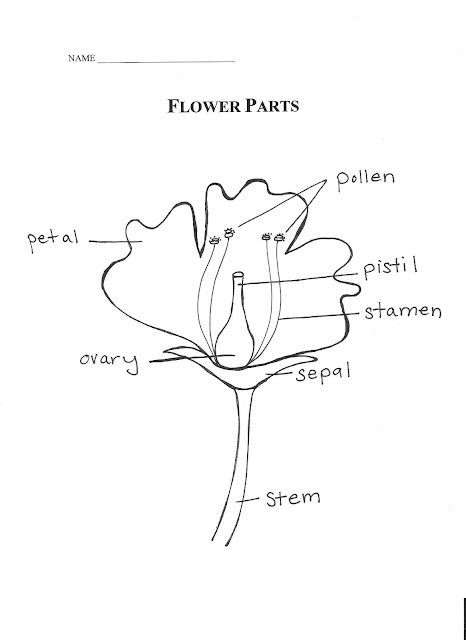
Who knows what dissection means? Dissection means to take something apart and look at the inside. Who wants to dissect a flower? (Have a diagram for each child that shows the different flower parts. Give each child a flower to dissect. Walk them through the different parts of the flower including the reproductive parts. Explain that pollen comes from the anthers, moves to the stigma, down the style, and into the ovary during pollination. A flower can pollinate itself, but many flowers require assistance from insects, wind, birds, or bats to move pollen from flower to flower which is called cross pollination).

Further discussion on pollination: What is pollination? Pollination is what happens when a flower turns into a seed, or a berry, or a fruit. The flower is beautiful and attractive and smells wonderful. Little insects come and get nectar from the flower. When they land on the flower, they get a little bit of pollen on them. Then they spread that pollen to the next flower they go to. That is exactly what the flower wants to have happen!!! Spreading pollen from one flower to the next is great!! Then the seed begins to grow.
Diagram of flower parts:

https://picasaweb.google.com/lh/photo/zFWLdGHD8kqRXYlKbOjN1dMTjNZETYmyPJy0liipFm0?feat=directlink


Game:
Pollination Game- have 6 cutouts of bees. Have 6 children be bees and the rest be flowers. Have the bees go from flower to flower and pollinate, until they have pollinated each. Then switch roles.


Song:
The Plant Part Song (Tune: The Farmer in the Dell)

The seed makes a plant.
With soil and rain and sunny days,
The seed makes a plant.

The roots find the water.
With soil and rain and sunny days,
The roots find the water.

The stem holds it up.
With soil and rain and sunny days,
The stem holds it up.

The leaves make the food.
With soil and rain and sunny days,
The leaves make the food.

The flower makes the fruit.
With soil and rain and sunny days,
The flower makes the fruit.

The fruit holds the seeds.
With soil and rain and sunny days,
The fruit holds the seeds.

Craft:
Handprint flowers- Give each child a piece of paper. Ask them to draw a stem and leaves. Paint each child’s hand with paint. Have them stamp their hand onto paper.