Welcome song
Letter of the Day- B and E (for bird and egg)
Did you know that birds are really special? They fly freely in sky. They sing beautiful songs. Birds hatch from eggs. They have feathers and wings, and they have beaks.
Song: Little bird, little bird
(two children stand in the middle holding hands, with their hands up high forming a bridge. The other children run under the bridge while we sing the song. At the end of the song, the two children in the middle let their hands down, in order to catch one of the kids in their arms).
Little bird, little bird fly through my window
Find molasses candy
Fly through my window, my little bird
Find molasses candy
Insert different types of birds in the place of "little bird" such as:
Blue Heron
Duck
Swallow
Sparrow
Starling
Crow
Eagle
Raven
Quail
Pigeon
Dove
Hummingbird
Chiadee
Game:
Duck, duck goose
Story: Tell the life cycle of the duck with the paper bag puppets. Give each child a puppet and tell the story from reproduction to reproduction. Have the children stand in front and hold up their puppet while you tell the story.
Role play: Let's pretend to be birds! Fly, build a nest, sit on eggs, catch worms, sit on a branch, call like a bird, etc.
Poem:
There's a wide eyed owl
With a pointed nose
Two pointy ears
And claws for toes
He lives high up in a tree
And when he looks at you
He flaps his wings and says...
"Whoooo whoooo!"
Books:
Birds
No Two Alike
Showing posts with label role play. Show all posts
Friday, January 8, 2016
Sunday, July 7, 2013
Lesson Plan- Ladybugs
Nature School
July 1st, 2013
Ladybugs
Welcome Song
Letter of the day
Ladybug fun facts:
1. There are about 4,300 kinds of ladybugs in the world.
2. Female ladybugs can eat as many as 75 aphids in one day!
3. Ladybugs smell with their feet and antennae.
4. A ladybug’s jaws chew side to side instead of up and down
like our jaws.
5. The color of a ladybug’s spots begin to fade as it gets older.
6. Ladybugs are most active when their body temperature is 75 degrees
or warmer.
7. A ladybug’s bright color warns birds that it does not taste good.
8. When a ladybug flies, its wings beat 85 times every second.
9. There are almost 400 different kinds of ladybugs in North America.
10. Female ladybugs are larger than male ladybugs.
Craft:
Cut and paste- Ladybug Life Cycle
Life Cycle:
Ladybugs aren’t so cute when they’re born—you may not even recognize them.
They hatch from eggs and look like tiny alligators. The new bug is called a larva, and it takes about 21 days for it to grow up to be a ladybug beetle.
Eggs
Mother ladybugs lay 10 to 15 eggs on the underside of a leaf. They look like tiny, elongated yellow jelly beans.
Larva
Larvae crawl out of their eggs and begin to look for food. Mother bugs make sure there are lots of aphids or mites nearby because the larvae will eat a lot of them before they become adults. Ladybug larvae look like tiny alligators—and they bite!
Bigger Larvae
After a few days, the little larvae begin to grow, and soon they shed their skins. This is called “molting,” and it happens several times. If you look closely you can see old skins clinging to leaves or to the grass in your ladybug jar.
Pupa
In about two weeks, the bigger larvae begin to look a little different, something like a lobster without legs and claws. They attach themselves to a leaf and hardly move at all. They are doing something extraordinary under their skins.
Imago or Adult
In another few days the ladybug splits its pupa and emerges looking very different. For the first few hours it’s pale and soft. Its shell quickly hardens. Its color becomes brighter. Now it looks just like its mother—a perfect adult ladybug beetle. What seems like amazing magic is one wonderful way the natural world works: ladybug metamorphosis.
How many of you have ever seen a real live ladybug? Did you pick it up? Were you afraid of it? Not very many people are afraid of ladybugs, are they? Ladybugs are kind of pretty, aren't they? When you see one it is hard not to want to pick it up and look at it a little closer. They kind of tickle when they walk on your arm, don't they?
Most people don’t mind having them around especially people who like to grow fruits and vegetables and flowers. They are glad to see them because they know that ladybugs are very helpful.
Along time ago the farmers in California had a big problem. Some very harmful insects, called the cottony-cushion scale, were eating and killing all their orange trees. They found out that the bug had been brought over from Australia by mistake on some ships. The insects weren’t so bad in Australia because Australia had ladybugs that ate the cottony-cushion scale. These farmers knew that they needed the Australian ladybugs to help them save their trees. So 500 ladybugs were sent to California. When they arrived they started eating the cottony-cushion scale and within two years the trees were saved. Yes, those ladybugs were very helpful. The trees were no longer dying.
Games:
Ladybug matching game
Ladybug fly through my window
Ladybug, Ladybug
Written by Nancy Foss
Ladybug, Ladybug turn around. (Have the children turn around.)
Ladybug, Ladybug touch the ground. (Have the children touch the ground.)
Ladybug, Ladybug show your love. (Use the sign language sign for "I love you.")
Ladybug, Ladybug point to heaven above. (Point up.)
Ladybug, Ladybug stomp your feet. (Stomp your feet.)
Ladybug, Ladybug take a seat. (Children all sit down.)
A Teeny, Tiny Ladybug
Written by Nancy Foss
(Sing to the tune of "Itsy, Bitsy Spider)
A teeny, tiny ladybug crawled up my arm this way. (Walk your fingers up your arm.)
Giggle, giggle, giggle this is what I say. (Hold your belly and laugh.)
Along came the wind and blew my friend away. (Blow wind with mouth and wave your arms.)
Out came the sun and my friend is here to stay. (Make sun with your arms.)
With a giggle, giggle, giggle we'll have fun today. (Hold your belly and laugh.)
Sunday, April 29, 2012
Lesson Plan- Flowers
Nature School
April 30th, 2012
Flowers
Welcome to Nature School today! Let’s sing our welcome song-
Letter of the Day:
Today we are going to be learning about flowers and pollination so our letter of the day is P for pollination. What other words do you know that start with P? Do any of our nature kids’ names start with P?
Who has seen some flowers blooming lately? There are lots of them, aren’t there? I’ve seen flowers on bushes, trees, and growing straight out of the ground!
Role Play:
Let’s pretend to be a flower. Let’s pretend our feet are roots. Plant them down in the dirt! Then stand up straight and tall. Your legs and your middle are the stem of the flower. Now, our arms and hands are our leaves. They help us photosynthesis and soak up sunlight. Now reach your neck up high and face the sun. That beautiful face of yours in the flower with its petals and beautiful bright colors. Oh, the sun feels so nice! Now it’s raining! We love the rain because it gives us a nice drink which we need to survive. Let’s slurp up some water with our roots. SLURP!! Now it’s really windy! Sway back and forth and side to side. Good thing we have a nice, strong stem to hold us up in the wind. Good job everyone!
Hike:
Who wants to go on a flower hike? As we hike, looks for flowers and point them out for everyone else, okay? Let’s see how many different flowers we can find.
Flower Dissection:
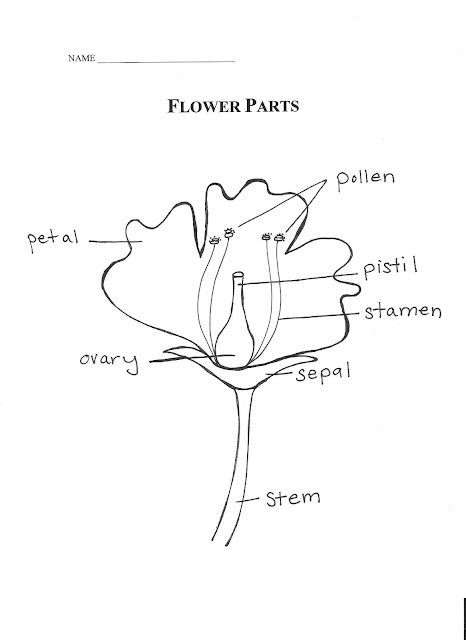
Who knows what dissection means? Dissection means to take something apart and look at the inside. Who wants to dissect a flower? (Have a diagram for each child that shows the different flower parts. Give each child a flower to dissect. Walk them through the different parts of the flower including the reproductive parts. Explain that pollen comes from the anthers, moves to the stigma, down the style, and into the ovary during pollination. A flower can pollinate itself, but many flowers require assistance from insects, wind, birds, or bats to move pollen from flower to flower which is called cross pollination).
Further discussion on pollination: What is pollination? Pollination is what happens when a flower turns into a seed, or a berry, or a fruit. The flower is beautiful and attractive and smells wonderful. Little insects come and get nectar from the flower. When they land on the flower, they get a little bit of pollen on them. Then they spread that pollen to the next flower they go to. That is exactly what the flower wants to have happen!!! Spreading pollen from one flower to the next is great!! Then the seed begins to grow.
Diagram of flower parts:
https://picasaweb.google.com/lh/photo/zFWLdGHD8kqRXYlKbOjN1dMTjNZETYmyPJy0liipFm0?feat=directlink
Game:
Pollination Game- have 6 cutouts of bees. Have 6 children be bees and the rest be flowers. Have the bees go from flower to flower and pollinate, until they have pollinated each. Then switch roles.
Song:
The Plant Part Song (Tune: The Farmer in the Dell)
The seed makes a plant.
With soil and rain and sunny days,
The seed makes a plant.
The roots find the water.
With soil and rain and sunny days,
The roots find the water.
The stem holds it up.
With soil and rain and sunny days,
The stem holds it up.
The leaves make the food.
With soil and rain and sunny days,
The leaves make the food.
The flower makes the fruit.
With soil and rain and sunny days,
The flower makes the fruit.
The fruit holds the seeds.
With soil and rain and sunny days,
The fruit holds the seeds.
Craft:
Handprint flowers- Give each child a piece of paper. Ask them to draw a stem and leaves. Paint each child’s hand with paint. Have them stamp their hand onto paper.
Sunday, March 18, 2012
Lesson Plan- Signs of spring
Nature School, March 19th, 2012
Signs of Spring
Spring will be here in two days! How can we tell that spring has arrived? What happens to our world in the spring? (days get longer, days get warmer, spring rain, tulips, daffodils, Easter, etc.)
Spring words: Here are some words that remind me of spring. Talk about the words with the kids. What do they think each word means and how it relates to spring.
Bud
Blossom
Flower
Stream
Melt
Green
Sunshine
Warm
Easter
Smell
Nest
Birds
Insects
Role Play: Find a place near a tree or bush.
Let’s pretend to be little seeds. We dropped from this tree last fall. We fell down to the ground and got covered up by leaves and dirt. We lay in the ground all winter long, feeling very cold and small. It was dark! The rain fell, the wind blew, the snow piled on top of us. Now the snow has melted. The rain falls, seeps through the soil, and we get wet! We are swelling up! Our tough seed coat that protected us all winter is getting soft. We burst through our seed coat!! Now our roots are uncurling deep into the soil. Then our stems begin to grow up, up, up, toward the soil’s surface. This is hard work! We have to push through the crusty, frozen surface of the soil. Finally! We break through and see the sun and feel the air. We begin to grow toward the sun. Our stem reaches upward higher and higher. Using the sun’s energy, we make food for ourselves which help us grow more. Our stem grows strong, our branches grow outward, our leaves begin to unfurl! We are now grown up plants with strong roots, stems, branches and big leaves!!
Hike: Let's take a hike around the wetland and look for our very own signs that spring is here. Give each child a laminated "signs of spring" worksheet and a dry erase pen.
Signs of Spring
| bud | blossom | nest |
| bird | water | frog eggs |
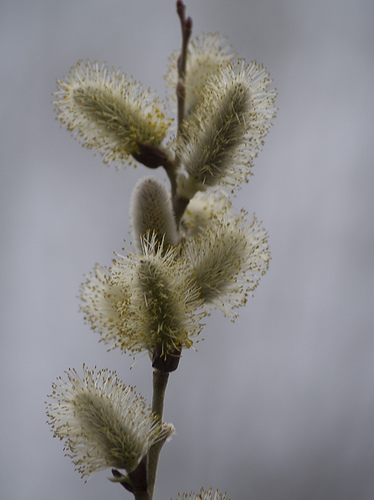
| pussy willow | thimbleberry | indian plum |
Link to "signs of spring" scavenger hunt worksheet
Friday, February 3, 2012
Sense of Smell (winter version) Lesson Plan
*We have an arboretum here in Seattle that has a "Winter Garden". This specialty garden is full of winter blooming trees, flowers, and bushes. It is incredible at this time of year! Some of my favorite winter blooming trees and plants are hamamelis (witch hazel), sarcococca (sweet box or Christmas box), helleborus (Christmas rose- although it is not part of the rose family), camellia, some early blooming prunus, and my absolute favorite Daphne. If you live in a city that has an arboretum or botanical garden, most likely it will have some wonderful winter-blooming plants. Winter is one of my favorite times to visit a garden. Seeing and smelling flowers in the winter feels like a gift from heaven and really lifts my spirit out of the doldrums of the cold and gray winter. Anyway, here is the lesson plan from last week:
What do we use our noses for? To smell! What do you think would happen if we couldn’t smell or we didn’t have a nose? We wouldn’t be able to taste our food very well. Isn’t that weird? Do you remember the last time you had a cold? Did your food taste different? That’s because our nose has cells that work when we eat food and tell our brain what our food tastes like.
Who is happy they have a nose? I sure am! Let’s take a walk and practice using our nose to discover the good smells that we find in nature. If you smell something that you really like, share it with everyone, please :)
The air smells ________
Sensory:
Scented playdough- I made three different scented playdoughs; cinnamon and cloves, rosemary, and peppermint. Give each child a little piece of playdough, let them smell it and play with it. Ask them which each playdough reminds them of. Which do they like the best.
Craft: Scented Flower
Materials:
Sense of Smell (winter version)
Letter of the day- N for nose!What do we use our noses for? To smell! What do you think would happen if we couldn’t smell or we didn’t have a nose? We wouldn’t be able to taste our food very well. Isn’t that weird? Do you remember the last time you had a cold? Did your food taste different? That’s because our nose has cells that work when we eat food and tell our brain what our food tastes like.
Who is happy they have a nose? I sure am! Let’s take a walk and practice using our nose to discover the good smells that we find in nature. If you smell something that you really like, share it with everyone, please :)
Rhyme: (As you walk along, find a place that has some flowers and some dirt. Have the kids take a deep breath of air, then chat the rhyme together. Have the children fill in the blanks with each verse. When you get to the dirt verse, scoop up a handful and have the children get close and smell. They will all have very different ideas about what it smells like! We had kids say "applesauce, toes, stinky, toast, etc).
The air smells ________
How do I know?
My nose told my brain,
So it must be so.
Flowers smell ______
How do I know?
My nose told my brain,
So it must be so.
The dirt smells ______
Flowers smell ______
How do I know?
My nose told my brain,
So it must be so.
The dirt smells ______
How do I know?
My nose told my brain,
So it must be so.
Games:
Smelly cups-
Prep- cut up an egg carton into individual little cups, one cup for each child in your class.
Give each child a egg carton cup. Find an area with a diversity of vegetation. Let them spend a few minutes picking up things from the ground or picking flowers, needles, dirt, leaves, grass, etc. that they find interesting to smell. Have them place a few items in their cup. Call the kid back together and tell them that we are going to play a game where we use our noses. Have the kids stand in a circle. Ask them to close their eyes and when you say “pass”, pass their cup to the left. They smell the cup in front of them for a moment then open their eyes to see what it is. When you say pass, they do it again and again, until all the cups have made it around the entire circle. Let the children talk about what different things they smelled and what they thought about the smells. Were they surprised? Did the smelly cups smell good, stinky, flowery, christmasy, spicy, strong, grassy? What was their favorite smell?
*note- this ended up panning out a bit differently than I had envisioned. Some of the kids were adamant about holding on to their little cup and did not want to pass it around. We ended up just walking around and smelling one anothers cup rather than passing them
Pretend Play:
Let's act out some animals that are "super smellers!"
-Dogs are super smellers! Have you ever watched a dog smell? How does the dog do it? Let’s pretend to be dogs! Let’s use our noses to tell us about the world around us!”
Pretend Play:
Let's act out some animals that are "super smellers!"
-Dogs are super smellers! Have you ever watched a dog smell? How does the dog do it? Let’s pretend to be dogs! Let’s use our noses to tell us about the world around us!”
-Bats are super smellers! Let's fly around catching insects with our good sense of smell.
-Sharks are super smellers! Let's swim around using our sense of smell to catch fish to eat.
-Rats are super smellers! Let's squeak like a rat and use our noses to find some garbage to eat :)
Sensory:
Scented playdough- I made three different scented playdoughs; cinnamon and cloves, rosemary, and peppermint. Give each child a little piece of playdough, let them smell it and play with it. Ask them which each playdough reminds them of. Which do they like the best.
Craft: Scented Flower
Materials:
Cotton balls enough for each child (with perfume or essential oil on each)
Felt flower cut outs
Paper flower cut outs
Floral wire
Directions:
Give each child of of each of the materials. Take the wire and poke through paper and felt, around the cotton ball and back through the felt and paper. Twist to make a stem.
Labels:
flowers,
games,
lesson plans,
nature crafts,
nose,
pretend play,
rhyme,
role play,
senses,
sensory,
smell,
winter
Subscribe to:
Posts (Atom)