Showing posts with label songs. Show all posts

Friday, January 8, 2016

Birds and eggs

Welcome song
Letter of the Day- B and E (for bird and egg)


Did you know that birds are really special? They fly freely in sky. They sing beautiful songs. Birds hatch from eggs. They have feathers and wings, and they have beaks.

Song: Little bird, little bird
(two children stand in the middle holding hands, with their hands up high forming a bridge. The other children run under the bridge while we sing the song. At the end of the song, the two children in the middle let their hands down, in order to catch one of the kids in their arms).

Little bird, little bird fly through my window
Find molasses candy
Fly through my window, my little bird
Find molasses candy

Insert different types of birds in the place of "little bird" such as:
Blue Heron
Duck
Swallow
Sparrow
Starling
Crow
Eagle
Raven
Quail
Pigeon
Dove
Hummingbird
Chiadee

Game:
Duck, duck goose

Story: Tell the life cycle of the duck with the paper bag puppets. Give each child a puppet and tell the story from reproduction to reproduction. Have the children stand in front and hold up their puppet while you tell the story.

Role play: Let's pretend to be birds! Fly, build a nest, sit on eggs, catch worms, sit on a branch, call like a bird, etc.

Poem:
There's a wide eyed owl
With a pointed nose
Two pointy ears
And claws for toes
He lives high up in a tree
And when he looks at you
He flaps his wings and says...
"Whoooo whoooo!"

Books:
Birds
No Two Alike

Sunday, July 7, 2013

Lesson Plan- Ladybugs


Nature School
July 1st, 2013
Ladybugs

Welcome Song

Letter of the day

Ladybug fun facts:
1.   There are about 4,300 kinds of ladybugs in the world.
2.   Female ladybugs can eat as many as 75 aphids in one day!
3.   Ladybugs smell with their feet and antennae.
4.   A ladybug’s jaws chew side to side instead of up and down
     like our jaws.
5.   The color of a ladybug’s spots begin to fade as it gets older.
6.   Ladybugs are most active when their body temperature is 75 degrees    
     or warmer.
7.    A ladybug’s bright color warns birds that it does not taste good.
8.   When a ladybug flies, its wings beat 85 times every second.
9.   There are almost 400 different kinds of ladybugs in North America.
10. Female ladybugs are larger than male ladybugs.

Craft:
Cut and paste- Ladybug Life Cycle

Life Cycle:
Ladybugs aren’t so cute when they’re born—you may not even recognize them.
They hatch from eggs and look like tiny alligators. The new bug is called a larva, and it takes about 21 days for it to grow up to be a ladybug beetle.
Eggs
Mother ladybugs lay 10 to 15 eggs on the underside of a leaf. They look like tiny, elongated yellow jelly beans.
Larva
Larvae crawl out of their eggs and begin to look for food. Mother bugs make sure there are lots of aphids or mites nearby because the larvae will eat a lot of them before they become adults. Ladybug larvae look like tiny alligators—and they bite!
Bigger Larvae
After a few days, the little larvae begin to grow, and soon they shed their skins. This is called “molting,” and it happens several times. If you look closely you can see old skins clinging to leaves or to the grass in your ladybug jar.
Pupa
In about two weeks, the bigger larvae begin to look a little different, something like a lobster without legs and claws. They attach themselves to a leaf and hardly move at all. They are doing something extraordinary under their skins.

Imago or Adult
In another few days the ladybug splits its pupa and emerges looking very different. For the first few hours it’s pale and soft. Its shell quickly hardens. Its color becomes brighter. Now it looks just like its mother—a perfect adult ladybug beetle. What seems like amazing magic is one wonderful way the natural world works: ladybug metamorphosis.

How many of you have ever seen a real live ladybug? Did you pick it up? Were you afraid of it? Not very many people are afraid of ladybugs, are they? Ladybugs are kind of pretty, aren't they? When you see one it is hard not to want to pick it up and look at it a little closer. They kind of tickle when they walk on your arm, don't they?
Most people don’t mind having them around especially people who like to grow fruits and vegetables and flowers. They are glad to see them because they know that ladybugs are very helpful.
Along time ago the farmers in California had a big problem. Some very harmful insects, called the cottony-cushion scale, were eating and killing all their orange trees. They found out that the bug had been brought over from Australia by mistake on some ships. The insects weren’t so bad in Australia because Australia had ladybugs that ate the cottony-cushion scale. These farmers knew that they needed the Australian ladybugs to help them save their trees. So 500 ladybugs were sent to California. When they arrived they started eating the cottony-cushion scale and within two years the trees were saved. Yes, those ladybugs were very helpful. The trees were no longer dying.


Games:
Ladybug matching game

Ladybug fly through my window

Ladybug, Ladybug
Written by Nancy Foss
Ladybug, Ladybug turn around. (Have the children turn around.)
Ladybug, Ladybug touch the ground. (Have the children touch the ground.)
Ladybug, Ladybug show your love. (Use the sign language sign for "I love you.")
Ladybug, Ladybug point to heaven above. (Point up.)
Ladybug, Ladybug stomp your feet. (Stomp your feet.)
Ladybug, Ladybug take a seat. (Children all sit down.)
A Teeny, Tiny Ladybug
Written by Nancy Foss
(Sing to the tune of "Itsy, Bitsy Spider)
A teeny, tiny ladybug crawled up my arm this way. (Walk your fingers up your arm.)
Giggle, giggle, giggle this is what I say. (Hold your belly and laugh.)
Along came the wind and blew my friend away. (Blow wind with mouth and wave your arms.)
Out came the sun and my friend is here to stay. (Make sun with your arms.)
With a giggle, giggle, giggle we'll have fun today. (Hold your belly and laugh.)

Sunday, April 29, 2012

Lesson Plan- Flowers

Nature School
April 30th, 2012
Flowers


Welcome to Nature School today! Let’s sing our welcome song-

Letter of the Day:
Today we are going to be learning about flowers and pollination so our letter of the day is P for pollination. What other words do you know that start with P? Do any of our nature kids’ names start with P?

Who has seen some flowers blooming lately? There are lots of them, aren’t there? I’ve seen flowers on bushes, trees, and growing straight out of the ground!

Role Play:
Let’s pretend to be a flower. Let’s pretend our feet are roots. Plant them down in the dirt! Then stand up straight and tall. Your legs and your middle are the stem of the flower. Now, our arms and hands are our leaves. They help us photosynthesis and soak up sunlight. Now reach your neck up high and face the sun. That beautiful face of yours in the flower with its petals and beautiful bright colors. Oh, the sun feels so nice! Now it’s raining! We love the rain because it gives us a nice drink which we need to survive. Let’s slurp up some water with our roots. SLURP!! Now it’s really windy! Sway back and forth and side to side. Good thing we have a nice, strong stem to hold us up in the wind. Good job everyone!

Hike:
Who wants to go on a flower hike? As we hike, looks for flowers and point them out for everyone else, okay? Let’s see how many different flowers we can find.

Flower Dissection:
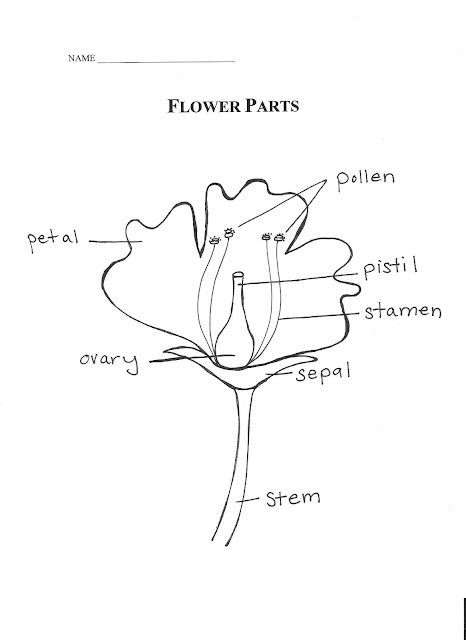
Who knows what dissection means? Dissection means to take something apart and look at the inside. Who wants to dissect a flower? (Have a diagram for each child that shows the different flower parts. Give each child a flower to dissect. Walk them through the different parts of the flower including the reproductive parts. Explain that pollen comes from the anthers, moves to the stigma, down the style, and into the ovary during pollination. A flower can pollinate itself, but many flowers require assistance from insects, wind, birds, or bats to move pollen from flower to flower which is called cross pollination).

Further discussion on pollination: What is pollination? Pollination is what happens when a flower turns into a seed, or a berry, or a fruit. The flower is beautiful and attractive and smells wonderful. Little insects come and get nectar from the flower. When they land on the flower, they get a little bit of pollen on them. Then they spread that pollen to the next flower they go to. That is exactly what the flower wants to have happen!!! Spreading pollen from one flower to the next is great!! Then the seed begins to grow.
Diagram of flower parts:

https://picasaweb.google.com/lh/photo/zFWLdGHD8kqRXYlKbOjN1dMTjNZETYmyPJy0liipFm0?feat=directlink


Game:
Pollination Game- have 6 cutouts of bees. Have 6 children be bees and the rest be flowers. Have the bees go from flower to flower and pollinate, until they have pollinated each. Then switch roles.


Song:
The Plant Part Song (Tune: The Farmer in the Dell)

The seed makes a plant.
With soil and rain and sunny days,
The seed makes a plant.

The roots find the water.
With soil and rain and sunny days,
The roots find the water.

The stem holds it up.
With soil and rain and sunny days,
The stem holds it up.

The leaves make the food.
With soil and rain and sunny days,
The leaves make the food.

The flower makes the fruit.
With soil and rain and sunny days,
The flower makes the fruit.

The fruit holds the seeds.
With soil and rain and sunny days,
The fruit holds the seeds.

Craft:
Handprint flowers- Give each child a piece of paper. Ask them to draw a stem and leaves. Paint each child’s hand with paint. Have them stamp their hand onto paper.


Sunday, March 11, 2012

Lesson Plan- St. Patrick's Day


Nature School, March 12th, 2012
St. Patrick’s Day


Supplies: Popsicle sticks, markers, cotton balls, glue, Popsicle stick puzzles (rainbow, leprechaun, and pot of gold), treasure with coins, clues hidden in the forest, 5 paper shamrocks.

Welcome to nature school today!! We are going to have so much fun!

Let’s sing our welcome song to everyone-

Our letter of the day is “S” for St. Patrick’s Day, which is this week.

Game:
Let’s play a game called “Hiding the Shamrock”. I’m going to call on a child to be it. He or she will hide the shamrock while the rest of us close our eyes. When the child is done, I’ll say “shamrock” and everyone tries to find it. If you find it, you get to be the next to hide it and so on.

Hike:
Leprechaun treasure hunt:
Today I have a very special adventure for you. First, I have to tell you a little bit about leprechauns. Does anyone know what a leprechaun is? Leprechauns are little Irish fairies that look like little old men. They wear a red or green coat and they enjoy being a little bit mischievous. Leprechauns spend all their time busily making shoes, and store away all their coins in a hidden pot of gold at the end of the rainbow. If ever captured by a human, the leprechaun has the magical power to grant three wishes and they will tell you where their treasure of gold is, in exchange for their release.

Well, I was lucky enough to catch a leprechaun and talk to him. He told me that his treasure was hidden here in this forest! He gave me some clues. So we are going to work together to find his treasure today! We will all share the treasure once we find it. It won’t be easy. We will have to search deep in the forest to find it. Are you ready?

Clue #1:
Cross a bridge
Over the creek
On the other side
A clue you will seek

Clue #2
Use your legs
To climb up the hill
You’ll have to work hard
To find a clue still

Clue #3
Left or right
Which way to go?
Head uphill
where the tall trees grow


Clue #4
Here is a place
where the path splits in two
Look for my footprint
of a leprechaun shoe

Clue #5
You are getting closer
You are almost there
If you go downhill
You’ll not find it anywhere

Clue #6
Look near a tree
Around at the ground
Near the base of its trunk
My treasure will be found


Song:
FIVE LITTLE SHAMROCKS
Place 5 paper shamrocks on the felt board or on the floor.

5 little shamrocks growing outside my door,
(child's name) picked one, and then there were 4.
4 little shamrocks, green as green could be,
(child's name) picked one, and then there were 3.
3 little shamrocks, sitting by my shoe,
(child's name) picked one, and then there were 2.
2 little shamrocks, enjoying the sun,
(child's name) picked one and that left 1.
1 little shamrock for Saint Patrick's Day fun,
(child's name) picked it, and that left none.
(Author unknown)

Group activity/problem solving
Popsicle Stick Puzzles:
Make up three of four Popsicle stick puzzles ahead of time. I made one with a leprechaun, a pot of gold, and a rainbow. Ask the children to split into groups of three or four and solve the puzzles as they work as a team. Then have the groups swap puzzles, until the children have has the chance to do every puzzle.

Game:
Who’s Sitting on  Gold…
A gold coin- chocolate foil covered, plastic, or a quarter wrapped in foil. Have the children sit on the ground in a circle or line. One child is designated as the leprechaun. Ask him/her to sit with back facing the children and gold coin sitting on the ground behind him/her.  Signal for one child to run and pick up the gold coin and sit on it. Then have the children say:
“Leprechaun, leprechaun where is your gold.
Someone stole it from your home”
The leprechaun has three guess to reveal the child.  The child who stole the gold than becomes the leprechaun.

Craft:
Popsicle stick rainbows. Give each child a popsicle stick and markers. Let them color a rainbow on it, you can tell the the color order or just let them be creative. I made an example ahead of time but I’ll encourage them to color theirs whatever way they would like. At the end of each popsicle stick, glue on two cotton balls.


Sunday, January 22, 2012

Lesson plan: Birds in the winter

Before I post this lesson plan, I have a confession...  I am a closet birder. I love watching and learning about birds. I feel like birding is kind of an old couple thing, so for some reason I'm embarrassed to admit this. Birds are so interesting to me, though. Last summer, I took my kids to this one wetland about 20 times just so I could check out the birds that live there. 


So, that being said, I think we've done about 4 nature school lessons on birds over the past year +. They are fun in the spring because they are busy building nests, collecting grass and twigs, and finding mates, in the summer because of the baby birds (especially the waterfowl!!), and in the fall because they are migrating and flying in v's. Here in the Seattle, I think the winter is equally, if not more, interesting! We have all these unique waterfowl that migrate from Alaska and Canada and make their winter home here in Seattle. You can't see them in the spring, summer, and fall because they migrate back North, so we have this exciting opportunity to go see them tomorrow. I'm excited!


Here is a link to the lesson plan- Birds in the winter lesson plan
Here is a link to the "birding with kids" handout- birding with kids handout


Nature School, Jan. 23rd, 2012
Birds in the winter
Seattle wetland area

Welcome Song

Letter of the day: W for winter and wetland

What happens to birds in the winter?
The migrate!

Facts about birds:
What do birds eat?
-insects (insectivores)
-worms, spiders, mice (carnivores)
-berries, nuts, seeds, grasses (herbivores)

baby birds hatch from their eggs by cutting their way out
birds have feathers
birds have wings ad can fly
birds have beaks
birds do not have teeth
birds have a special bone in their tongue

Listening and Watching Activity:

Give each child the “Birding for kids” handout- https://docs.google.com/document/pub?id=13MA_iyWAwFcNsXsc2X_nOpunNuatNWMuqwU9q7OA_sI
Encourage the kids to stop, look and listen. Birds sing, they protect their territory, they attract mates, they hunt for food. This behavior is fascinating to watch. Make sure the children in your life notice these things.

Ask the kids to listen to the bird songs and see if they can distinguish one from another. They may enjoy imitating the bird calls.

Ask the kids to find a quiet spot and watch for birds. What different colors did they see How big were the birds they saw? What did their beaks look like?

Role Play:
Act out the day in the life of a bird with the duck puppets

Games:
Duck, duck, goose

Songs:

Little bird
Little bird, little bird, fly through my window
Find molasses candy
Through my window, my sugar lump
Fly through my window, my sugar lump
Find molasses candy

Bluebird, bluebird....
Hummingbird, hummingbird....
Woodpecker, woodpecker.....
Let the kids tell you their favorite bird

(this song can be sung along with a game. Have the children stand in the circle holding hands with their arms up in arches to form “windows” during the song. One kid is the little bird who flies in and out of the arches or “windows”. During the second verse, the “bird” chooses another child by patting him or her on the shoulder. The next child becomes the bird who flies through the window.)


Little Bird (sung to "Up on the housetop")
Most of the bird have gone away
On this cold, dark winter day,
But here is one bird I can see.
Looking for something to eat.
Little bird, I'll feed you
Till the cold winter's through
And all your friends come back to play,
On some bright and warm spring day.


How can we help take care of birds in the winter?
Craft: Toilet paper bird feeder. Take a toilet paper roll and spread shortening on it, then roll it in bird seed. It can be hung on a tree by simply sliding it onto a tree branch.


Union Bay Natural Area Winter Birding:
Winter is waterfowl season at the Fill. We routinely get Mallard, Gadwall, Green-winged Teal, the occasional Eurasian Teal (same guy who's been coming for the past two years), American and Eurasian Wigeon, Northern Pintail, Northern Shoveler, overwintering Cinnamon Teal, Canvasback, occasional Redhead, Ring-necked, Greater and Lesser Scaup (good opportunities to compare), Common Goldeneye, Bufflehead, Common Merganser, Hooded Merganser, and Ruddy. Three Trumpeter Swans who grew up here a few winters ago now return each year with their mates.
We usually host overwintering Virginia Rails, Marsh Wrens, Green Herons, and Savannah Sparrows. Winter is the time when Western Scrub-Jays appear, along with other winter rarities such as Red-breasted Sapsucker (a male who makes the Fill part of his circuit), Varied Thrush, Western Meadowlark, Band-tailed Pigeon, Eurasian Collared-Dove, and Pacific Wren.
In late 2011 we had our first Barred Owl. Also, back from who knows where, Short-eared Owl.

If you're lucky: Distinct possibilities in 2011-2012 are Tufted Duck, Barrow's Goldeneye, Western Screech-Owl, Cattle Egret, Rough-legged Hawk, any longspur, Snow Bunting, Tropical Kingbird, both redpolls, Snowy Owl, Northern Wheatear, Lewis's Woodpecker, a wagtail, Bohemian Waxwing, and Palm Warbler.


Sunday, January 15, 2012

Hibernation Lesson Plan

*note- We did this lesson in November when the weather began to change from fall to winter here in Seattle. It could be done anytime in the fall, winter, or even spring when things begin to warm up. This lesson has a lot of material. It could be divided into a couple of different lessons. 


Hibernation

Welcome Song

Letter of the day- H

Today we are going to learn about HIBERNATION! Does anyone know what that word means?

Winter is cold.  There are cold rains and winds that blow. Soon, there will be snow on the ground.  Where to do we go to stay warm in the winter? What do we eat in the winter? What do we wear in the winter? (Let each child have a turn answering)


What do animals do in the winter?
Some animals get very sleepy during the winter months when the weather gets cold and they take a nap. This is called hibernation. There are lots of different ways that animals hibernate. Some animals fall asleep very deeply for a few months. Some sleep more lightly and wake up every so often. When animals hibernate they don’t need to eat very food. Some don’t even eat at all!
Do you know of any animals that hibernate in the winter?
Bears
Chipmunks
Frogs
Snakes
Bugs
Other animals stay active in winter. It is hard for them to find food. They may live in holes in trees or under the ground to stay warm. Here are a few animals that stay active:

Deer
Squirrels
Rabbits


Migration- Some birds fly south for the winter. We call this migration. They go to a warmer place to find food. Other birds stay here all winter. We can help by feeding them.

Story
You can make up any story you want. Here is the one I told- 

“I have a little friend who lives in the forest.  Her name is Sally Chipmunk. She lives with her brothers and sisters in a hollow tree.  They have such a lovely, warm, snuggly home. During the spring, summer, and fall, Sally eats and eats and eats. She eats so much because she knows that when fall ends and the cold wind blows, there will be no more food to gather and she will take a long, warm nap with her brothers and sisters. So during the warm summer months, she and her siblings gather leaves and grass and moss to make their hollow tree home warm and comfortable. 
Right around now, Sally takes a look at the beautiful forest she calls home, closes the door to her home tight and pads it with sticks and leaves, and nestles into her little bed. She closes her eyes and falls asleep! Now, do you think she closes her eyes and sleeps for just one night like you and I? No! When she wakes up weeks have passed! When she wakes up the buds are forming on the trees and the daffodils and crocuses are popping up from the ground. The snow has come and gone and it is spring! Sally and her brothers and sisters stretch, stretch, stretch. They climbed out of their home and into the sunshine. Sally took a big huge breath. The air smelled like Spring! Spring had arrived.


Action Poems
Winter is cold (Hug yourself and shiver)
There is snow in the sky (Flutter fingers above your head)
The squirrel gathers nuts (Pretend to gather nuts)
And the wild geese fly (Flap arms)
The fluffy red fox (Cup hands over head to form ears)
Has his fur to keep warm (Stroke arms as if stroking fur)
The bear's in her cave (Form a cave shape with your arms)
Sleeping all through the storm (Fold hands under cheek and pretend to sleep)


Here is a cave. (bend fingers to form cave)
Inside is a bear. (put thumb inside fingers)
Now he comes out. (thumb out)
To get some fresh air.
He stays out all summer
In sunshine and heat.
He hunts in the forest
For berries to eat. (move thumb in circle)
When snow starts to fall
He hurries inside.
His warm little cave (thumb in)
And there he will hide.
Snow covers the cave
Like a fluffy white rug. (cover with other hand)
Inside the bear sleeps
All cozy and snug.


As we go on our hike, let’s pretend to be very, very, sleepy bears. Let’s find a place to take a winter’s nap. We will keep our eyes open for comfy places that animals, birds, and insects might like to take a nap. When we find a place to sleep, let's all lie down and pretend to hibernate!


Song
"Bear is sleeping
Bear is sleeping,
in her cave
in her cave,
wonder when she'll wake up
wonder when she'll wake up,
in the spring
in the spring..."
(we started with a bear puppet buddy and followed with: bat in her cave, skunk in his den, ground squirrel in the ground, ladybug under a log, snail in her shell, turtle in the pond.)


Hibernation craft-
Here is a very cute idea for a little animal in a cave found at this neat blog- http://almostunschoolers.blogspot.com/2011/10/bears-are-still-awake-hibernation-craft.html

Additional information on hibernation, migration, and adaptation

MIGRATE
Animals do many different, amazing things to get through the winter. Some of them "migrate." This means they travel to other places where the weather is warmer or they can find food.
Many birds migrate in the fall. Because the trip can be dangerous, some travel in large flocks. For example, geese fly in noisy, "V"-shaped groups. Other kinds of birds fly alone.
How do they know when it is time to leave for the winter? Scientists are still studying this. Many see migration as part of a yearly cycle of changes a bird goes through. The cycle is controlled by changes in the amount of daylight and the weather.
Birds can fly very long distances. For example, the Arctic tern nests close to the North Pole in the summer. In autumn, it flys south all the way to Antarctica. Each spring it returns north again.
Most birds migrate shorter distances. But how do they find their way to the same place each year? Birds seem to navigate like sailors once did, using the sun, moon and stars for direction. They also seem to have a compass in their brain for using the Earth's magnetic field.
Other animals migrate, too. There are a few mammals, like some bats, caribou and elk, and whales that travel in search of food each winter. Many fish migrate. They may swim south, or move into deeper, warmer water.
Insects also migrate. Some butterflies and moths fly very long distances. For example, Monarch butterflies spend the summer in Canada and the Northern U.S. They migrate as far south as Mexico for the winter. Most migrating insects go much shorter distances. Many, like termites and Japanese beetles, move downward into the soil. Earthworms also move down, some as far as six feet below the surface.

ADAPT
Some animals remain and stay active in the winter. They must adapt to the changing weather. Many make changes in their behavior or bodies. To keep warm, animals may grow new, thicker fur in the fall. On weasels and snowshoe rabbits, the new fur is white to help them hide in the snow.
Food is hard to find in the winter. Some animals, like squirrels, mice and beavers, gather extra food in the fall and store it to eat later. Some, like rabbits and deer, spend winter looking for moss, twigs, bark and leaves to eat. Other animals eat different kinds of food as the seasons change. The red fox eats fruit and insects in the spring, summer and fall. In the winter, it can not find these things, so instead it eats small rodents.
Animals may find winter shelter in holes in trees or logs, under rocks or leaves, or underground. Some mice even build tunnels through the snow. To try to stay warm, animals like squirrels and mice may huddle close together.
Certain spiders and insects may stay active if they live in frost-free areas and can find food to eat. There are a few insects, like the winter stone fly, crane fly, and snow fleas, that are normally active in winter. Also, some fish stay active in cold water during the winter.


HIBERNATE
Some animals "hibernate" for part or all of the winter. This is a special, very deep sleep. The animal's body temperature drops, and its heartbeat and breathing slow down. It uses very little energy. In the fall, these animals get ready for winter by eating extra food and storing it as body fat. They use this fat for energy while hibernating. Some also store food like nuts or acorns to eat later in the winter. Bears, skunks, chipmunks, and some bats hibernate.

AND MORE
Cold-blooded animals like fish, frogs, snakes and turtles have no way to keep warm during the winter. Snakes and many other reptiles find shelter in holes or burrows, and spend the winter inactive, or dormant. This is similar to hibernation.
Water makes a good shelter for many animals. When the weather gets cold, they move to the bottom of lakes and ponds. There, frogs, turtles and many fish hide under rocks, logs or fallen leaves. They may even bury themselves in the mud. They become dormant. Cold water holds more oxygen than warm water, and the frogs and turtles can breath by absorbing it through their skin.
Insects look for winter shelter in holes in the ground, under the bark of trees, deep inside rotting logs or in any small crack they can find. One of the most interesting places is in a gall. A gall is a swelling on a plant. It is caused by certain insects, fungi or bacteria. They make a chemical that affects the plant's growth in a small area, forming a lump. The gall becomes its maker's home and food source.
Every type of insect has its own life cycle, which is the way it grows and changes. Different insects spend the winter in different stages of their lives. Many insects spend the winter dormant, or in "diapause." Diapause is like hibernation. It is a time when growth and development stop. The insect's heartbeat, breathing and temperature drop. Some insects spend the winter as worm-like larvae. Others spend the winter as pupae. (This is a time when insects change from one form to another.) Other insects die after laying eggs in the fall. The eggs hatch into new insects in the spring and everything begins all over again.