Showing posts with label hands on science. Show all posts

Sunday, May 19, 2013

Lesson Plan- Inchworms


Nature school
May 20th, 2013
Inchworms

Welcome song

Letter of the day- I for inchworms

Facts:
-Inchworms are interesting! They are not actually worms- they are caterpillars. They metamorphose into brown moths called Geometer moths. These moths are like butterflies, but they are nocturnal!
-Inchworms are green, yellow, brown or grey. They protect themselves from predators by blending in with their surroundings!
-Inchworms love to eat oak tree leaves. Maybe we can find some inchworms by finding an oak tree and looking at its leaves!
-What do you think might eat inchworms? birds, wasps, lizards, spiders
-Inchworms can spin thread, like spiders! They use the thread they spin to drop to the ground
-Inchworms don’t have to drink water because they get all the water they need from the leaves they eat.

Pretend Play:
They move by looping their bodies. They do this is because they have three pairs of legs in the front and two or three pairs in the back, but no legs in the middle of their abdomen. So they move by bringing their hind end towards it’s front, over and over. Let’s pretend to be inchworms!

Fingerplay:
Inchworms
5 little inchworms crawling up my door
one fell off and then there were 4
4 little inchworms inching up a tree
one fell off and then there were 3
3 little inchworms crawling on my shoe
one fell off and then there were 2
2 little inchworms in the summer sun
one found some shade, then there was one
1 little inchworm tired from the fun
inched off to bed, then there were none

Craft: Inchworm bracelet
Pasta dyed green
Twine cut to the size of child’s wrist + a little
-have the children string three pieces of pasta onto twine. Tie around wrist

Books:
Inch by Inch

Math/Science:
Let’s all collect some little twigs, leaves, flowers, and sticks! Then we will measure them and see how many inches long they are. They we will make a little chart to compare!


Sunday, May 5, 2013

Lesson Plan- Clouds


Nature School
May 6, 2013
Clouds!

Welcome Song

Hello everyone! I’m so excited to see all you kiddos today! We are going to have so much fun on our hike, looking for some interesting things in nature. Today, we are going to learn about something that we see up in the sky, it’s big and white and sometimes round of puffy shaped. What is it? Clouds!

Letter of the day- C

What are clouds?
Did you know that clouds are a collection of tiny, tiny water droplets way high up in the sky?

How do clouds form?
All air around us has water in it. Did you know that? The water in the air gets warm. It starts to rise up. It goes so high in the air, but way up high the air is actually colder. There are also little air dust particles up high in the air that the water vapor clings onto. When they all clump together, then clouds are formed. When there gets to be too much water in the cloud, then it rains!

Science experiment-
2 Plastic bags
2 cups
water
Let’s put some water in this cup and place the cup in this plastic bag. One of the bags we will leave open and the other, we will close. What do you think is going to happen? Let’s see what happens when we get back from our hike and talk about it.

Clouds are really cool. They can tell us things! Did you know that you can tell what kind of weather is coming by looking up in the sky at the clouds?
- Long, wispy cirrus clouds= pleasant or fair weather. Usually indicate a change in the weather in the next 24 hours
- Cirrostratus clouds= long, sheet like cloud that covers entire sky, but sun or moon can still be seen through them. They usually indicate there will be rain or snow in the next 12 to 24 hours
- Puffy, cotton ball Cumulus clouds= good weather!
- Thick, grey Stratus clouds= that is what we have in Seattle almost all winter. These clouds mean a little drizzle here or there
Let’s all lie on our backs and look at the clouds for a bit. What shapes to do you? Do you think the clouds are high or low? Are the moving fast or slow? Are the white or grey?

Story- Drippy the raindrop (cutouts of drippy, salty, tree, cloud, and sun)
Once upon a time there was a raindrop named Drippy (picture of drop of water). Drippy was having fun! He was doing his favorite thing in the whole wide world- lying on his back floating in the ocean. He looked up at his good old friend Mr. Sun, who had just come up (hold up picture of sun). Mr. Sun rose higher and higher and Drippy got hotter and hotter!

Just then, Drippy saw a big, dark cloud moving across the sky. “I wish I could go up to that cool looking cloud and cool down a bit!”

All of a sudden, Drippy felt himself rising up into the air! He was evaporating! Can we all saw evaporate together? EVAPORATE!
He landed softly on a huge, fluffy cloud. There were thousands of other drops of water too. One of the drops of water called out to Drippy, “Ahoy there! I’m Salty!” (hold up picture of another drop of water with captain hat on).

“I’m Drippy! Nice to meet you. Where are we headed?”

“We are going right toward those mountains over there and it looks like a storm is a brewing. If things get rough, just abandon ship. Jump right off the cloud and toward the earth” Salty said.

After awhile, things did start getting rough. Drippy got ready to jump. 1-2-3-JUMP! Drippy was raining now! He fell with millions of other raindrops down toward the forest near the mountains.

Drippy landed right on a tree (show picture of tree with roots). He slid down on leaf onto a branch and then down the trunk. Down, down, down he slid down the trunk and into the soil near the tree’s roots. Wow! What an adventure we was having. When we reached the soil, he found lots of other water drops there too. They were filling up the soil pores. He sunk deeper into the soil and into an underground stream. Then, guess what happened? The underwater stream came out of the ground as a spring!! The stream was now above ground. The stream eventually led him out into the ocean again!

Drippy leaned back, floating on his back and looked up at his good friend Mr. Sun again. “Hello there, Mr. Sun!” What an adventure I’ve had! I’ve been through the water cycle. Can you all say WATER CYCLE? I’m learned so much and seen so much of our beautiful earth. What a wonderful world we live in!”
The end

Craft-
Paper clouds
Yarn
Paper rain droplets
Give each child a cloud, three pieces of yarn and three rain droplets. Let them color the rain droplets or cloud if they would like. Have them glue the cloud down on another piece of paper, hang yarn from cloud, then attach the rain droplets.

Song- to the tune of “the farmer and the dell”
The clouds are floating by
the clouds are floating by
heigh-ho, just watch them go
the clouds are floating by

They’re sometime high or low
they’re sometime high or low
heigh-ho, just watch them go
they’re sometimes high or low

Clouds move fast or slow
clouds move fast or slow
heigh-ho, just watch them go
clouds move fast or slow

Monday, April 15, 2013

Lesson plan- Pillbugs


Nature School
Pill Bugs
April 15th, 2013


Welcome Song


Letter of the day- P for pillbug


Today we are going to learn about Pill Bugs! Sometimes we call them Potato Bugs or roly-pollies. Has anyone seen one before? Sometime we find them rolled up in a ball or under dried leaves. Have you ever looked under a rock or piece of wood and found some pill bugs?

Can you try and roll up like a pill bug? Let's all try!


Pictures of pill bugs:


Pill Bug facts:
-They live in your garden, under a flower pot, under rotting leaves, anywhere where they can eat rotting and decaying matter.
-They like to eat all the time! Their poop is square shaped! Isn't that strange?
-Pill bugs are not insects at all! They are crustaceans- like crab and shrimp
-Pill bugs live on land- but they can swim for a little bit if they accidently fall into the water
-In addition to eating decaying matter- pill bugs also eat bits of concrete and rocks to help with their digestion
-To protect themselves against predators (ants, frogs, lizards, lots of animals), they roll themselves into a ball.
-They have an exoskelton which they shed many times as they grow. First they shed their rear half, and the next day they shed their front half.
- In the fall, they dig deep into the ground and sleep until spring!


Pill Bug races- Use markers stacked top to bottom, lie them down on the ground to make different track lanes. Line up pill- bugs and let them go.

Make a pill bug maze with rocks, twigs, and sticks. See how quickly the pill bug can make it’s way through the maze.

Roly-poly relay races:
Tie two kids legs together like a two legged race. Tell the kids that they are like a pill-bug and must work together to coordinate their movements. Pill-bugs have seven pairs of legs!


Make a Pill Bug House:
1. Put a few inches of soil into the box
2. Find a rock or piece of concrete in the box
3. Find some moss, piece of potato, carrot peelings, bits of fruit, bit of lettuce. Mostly, pill bug love dried leaves and rotting pieces of wood. And a bit of shredded newspaper
4. Find a few pill bugs. Look under leaves or turn over a rock
5. Keep your pill bug home moist by spraying lightly with water once a day


Sunday, April 29, 2012

Lesson Plan- Flowers

Nature School
April 30th, 2012
Flowers


Welcome to Nature School today! Let’s sing our welcome song-

Letter of the Day:
Today we are going to be learning about flowers and pollination so our letter of the day is P for pollination. What other words do you know that start with P? Do any of our nature kids’ names start with P?

Who has seen some flowers blooming lately? There are lots of them, aren’t there? I’ve seen flowers on bushes, trees, and growing straight out of the ground!

Role Play:
Let’s pretend to be a flower. Let’s pretend our feet are roots. Plant them down in the dirt! Then stand up straight and tall. Your legs and your middle are the stem of the flower. Now, our arms and hands are our leaves. They help us photosynthesis and soak up sunlight. Now reach your neck up high and face the sun. That beautiful face of yours in the flower with its petals and beautiful bright colors. Oh, the sun feels so nice! Now it’s raining! We love the rain because it gives us a nice drink which we need to survive. Let’s slurp up some water with our roots. SLURP!! Now it’s really windy! Sway back and forth and side to side. Good thing we have a nice, strong stem to hold us up in the wind. Good job everyone!

Hike:
Who wants to go on a flower hike? As we hike, looks for flowers and point them out for everyone else, okay? Let’s see how many different flowers we can find.

Flower Dissection:
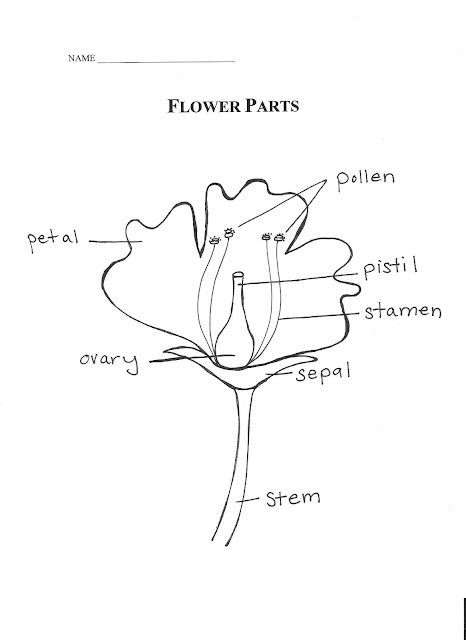
Who knows what dissection means? Dissection means to take something apart and look at the inside. Who wants to dissect a flower? (Have a diagram for each child that shows the different flower parts. Give each child a flower to dissect. Walk them through the different parts of the flower including the reproductive parts. Explain that pollen comes from the anthers, moves to the stigma, down the style, and into the ovary during pollination. A flower can pollinate itself, but many flowers require assistance from insects, wind, birds, or bats to move pollen from flower to flower which is called cross pollination).

Further discussion on pollination: What is pollination? Pollination is what happens when a flower turns into a seed, or a berry, or a fruit. The flower is beautiful and attractive and smells wonderful. Little insects come and get nectar from the flower. When they land on the flower, they get a little bit of pollen on them. Then they spread that pollen to the next flower they go to. That is exactly what the flower wants to have happen!!! Spreading pollen from one flower to the next is great!! Then the seed begins to grow.
Diagram of flower parts:

https://picasaweb.google.com/lh/photo/zFWLdGHD8kqRXYlKbOjN1dMTjNZETYmyPJy0liipFm0?feat=directlink


Game:
Pollination Game- have 6 cutouts of bees. Have 6 children be bees and the rest be flowers. Have the bees go from flower to flower and pollinate, until they have pollinated each. Then switch roles.


Song:
The Plant Part Song (Tune: The Farmer in the Dell)

The seed makes a plant.
With soil and rain and sunny days,
The seed makes a plant.

The roots find the water.
With soil and rain and sunny days,
The roots find the water.

The stem holds it up.
With soil and rain and sunny days,
The stem holds it up.

The leaves make the food.
With soil and rain and sunny days,
The leaves make the food.

The flower makes the fruit.
With soil and rain and sunny days,
The flower makes the fruit.

The fruit holds the seeds.
With soil and rain and sunny days,
The fruit holds the seeds.

Craft:
Handprint flowers- Give each child a piece of paper. Ask them to draw a stem and leaves. Paint each child’s hand with paint. Have them stamp their hand onto paper.


Sunday, March 4, 2012

Mushroom lesson

About a month ago, we had a local mushroom expert come and teach us about fungi! He taught us how to put together our very own mushroom kits. It takes a few weeks for the mushrooms to flower, so we are all, now, enjoying our very own, homegrown oyster mushrooms :)

Here are a few picture from our mushroom lesson:


Sunday, February 19, 2012

Lesson plan- Sharing

Nature School Feb. 20th, 2012
Sharing

Welcome song

We’ve been talking about love with Valentine’s this month. Today let's learn about sharing! Sharing is another way we show love for our friends and family.

Letter of the Day:
S for sharing
Who can tell me what sharing is?
When you share a toy with a friend, does it mean they keep it forever? No :) It’s good for me to remember that when I’m having a hard time sharing. Who feels happy when they share? I do!

Sharing Chart:
There are so many things that are more fun to do with a friend than alone. Let’s fill out a sharing chart. Let’s say whether we like doing these things with a friend or family, or doing them all alone (some things on the chart could go either way, for instance “reading a book”).

Playing a game
Eating cookies
Brushing teeth
Getting Dressed
Going on a bike ride
Going for a hike
Eating dinner
Snuggling
Seeing a rainbow
Reading a book
Finding a beautiful flower
Playing with trains or cars
Playing dress up
Making music
Brushing your hair
Doing chores

Group Sharing:
Everyone brought something that they would like to share with the other kids. Let’s take turns sharing with one another about what we brought.

Books:
Rabbit’s Gift- http://www.amazon.com/Rabbits-Gift-George-Shannon/dp/0152060731
The Please and Thank You Book- http://www.amazon.com/Please-Thank-Book-Little-Golden/dp/0375847588

Rhyme:
Three little sailors set out to sea.
They worked together happily.
Everyone cleaned, everyone rowed,
Everyone fished, everyone sewed.
When they got home
They stood side-by-side.
Their boat full of fish,
Their hearts full of pride!

Game:
Picture puzzles- this game will help teach the children to work together and share with one another.
Find pictures from National Geographic or any other magazine with neat pictures. Mount them onto cardstock. Cut in half. Make sure you have enough for each child to get a half. Pass out the puzzle pieces. Tell the children they need to find their puzzle partner. Let them play the game multiple times by gathering and re-distributing the picture puzzle pieces.

Hands On:
Packet of Sugar Snap Peas
Dirt/Potting soil
Egg carton cut up into individual little cups

Planting peas- I brought seeds, dirt, and egg carton cups for everyone to plant a pea seed. This pea seed will grow into a pea plant with LOTS of sugar snap peas to share with your friends and family. Planting seeds is such a special way to share with others, because with one seed, you can have a big beautiful plant grow. Plants make our planet happy too! When we plant seeds, we are sharing the beauty of the earth with others too.


Sunday, January 1, 2012

Water lesson plan

Nature School, Jan. 2nd, 2012
Water


Materials:
Letter of the day
One cotton ball for each child
Flat pan or tupperware (doesn’t have to be too big) with a little water in it
Cuttouts from “Drippy” story- raindrop, raindrop with captain hat, sun, tree, mountain
Chart with water/non water columns and cutouts of items

Welcome Song

Today we are going to learn about water! Our letter for the day is W (show paper with upper and lower case W on it). Talk about some other words that start with W or children’s names that start with that letter. Water, wish, wash, whale, whiskers, watermelon, where, etc.

Why is water important?
Why do we need water?- drink, clean, work, energy
Why do animals need water?- drink, habitat, clean
Why do plants need water?- growing, photosynthesis

Song-
There is something we need to live and water is its name-o.
W-A-T-E-R, W-A-T-E-R, W-A-T-E-R, and water is its name-o.

Story- Drippy the raindrop
Once upon a time there was a raindrop named Drippy (picture of drop of water). Drippy was having fun! He was doing his favorite thing in the whole wide world- lying on his back floating in the ocean. He looked up at his good old friend Mr. Sun, who had just come up (hold up picture of sun). Mr. Sun rose higher and higher and Drippy got hotter and hotter!

Just then, Drippy saw a big, dark cloud moving across the sky. “I wish I could go up to that cool looking cloud and cool down a bit!”

All of a sudden, Drippy felt himself rising up into the air! He was evaporating! Can we all saw evaporate together? EVAPORATE!

He landed softly on a huge, fluffy cloud. There were thousands of other drops of water too. One of the drops of water called out to Drippy, “Ahoy there! I’m Salty!” (hold up picture of another drop of water with captain hat on).

“I’m Drippy! Nice to meet you. Where are we headed?”

“We are going right toward those mountains over there and it looks like a storm is a brewing. If things get rough, just abandon ship. Jump right off the cloud and toward the earth” Salty said.

After awhile, things did start getting rough. Drippy got ready to jump. 1-2-3-JUMP! Drippy was raining now! He fell with millions of other raindrops down toward the forest near the mountains.

Drippy landed right on a tree (show picture of tree with roots). He slid down on leaf onto a branch and then down the trunk. Down, down, down he slid down the trunk and into the soil near the tree’s roots. Wow! What an adventure we was having.

When we reached the soil, he found lots of other water drops there too. They were filling up the soil pores. He sunk deeper into the soil and into an underground stream. Then, guess what happened? The underwater stream came out of the ground as a spring!! The stream was now above ground. The stream eventually led him out into the ocean again!

Drippy leaned back, floating on his back and looked up at his good friend Mr. Sun again. “Hello there, Mr. Sun!” What an adventure I’ve had! I’ve been through the water cycle. Can you all say WATER CYCLE? I’m learned so much and seen so much of our beautiful earth. What a wonderful world we live in!”

The end

Hands on Science
-Give each child a cotton ball to hold. Tell them to pretend they are hold a cloud.
-How does it feel- heavy or light, soft or hard
-Tell the kids to place their cotton ball into the container of water. When water evaporates, it travels up into the clouds and it is much colder up in the sky, so the vapor turns back into water and fills up the cloud.
- Ask the children the gently pick up their “cloud” from the pan. Ask how their cloud feels now? Heavy or light? Warm or cold?
- What is happening to the water now? Dripping out of your cloud. It is raining! At some point, the clouds cannot hold anymore water because the water gets so heavy, so the water starts to fall out of the clouds turning to rain!
- The water fall back into the pan, which we can pretend is a stream or the ocean, right back into the water cycle.

Chart- What is water/not water
Cutouts of the following- icicle, cloud, river, snowflake, steam, piano, hair, rock, blanket, mug, fork, human, animals, plant, etc.
Chart with two columns- one that says “Water” and another with “not water”