Welcome song
Letter of the Day- B and E (for bird and egg)
Did you know that birds are really special? They fly freely in sky. They sing beautiful songs. Birds hatch from eggs. They have feathers and wings, and they have beaks.
Song: Little bird, little bird
(two children stand in the middle holding hands, with their hands up high forming a bridge. The other children run under the bridge while we sing the song. At the end of the song, the two children in the middle let their hands down, in order to catch one of the kids in their arms).
Little bird, little bird fly through my window
Find molasses candy
Fly through my window, my little bird
Find molasses candy
Insert different types of birds in the place of "little bird" such as:
Blue Heron
Duck
Swallow
Sparrow
Starling
Crow
Eagle
Raven
Quail
Pigeon
Dove
Hummingbird
Chiadee
Game:
Duck, duck goose
Story: Tell the life cycle of the duck with the paper bag puppets. Give each child a puppet and tell the story from reproduction to reproduction. Have the children stand in front and hold up their puppet while you tell the story.
Role play: Let's pretend to be birds! Fly, build a nest, sit on eggs, catch worms, sit on a branch, call like a bird, etc.
Poem:
There's a wide eyed owl
With a pointed nose
Two pointy ears
And claws for toes
He lives high up in a tree
And when he looks at you
He flaps his wings and says...
"Whoooo whoooo!"
Books:
Birds
No Two Alike
Showing posts with label games. Show all posts
Friday, January 8, 2016
Thursday, September 17, 2015
Lesson Plan- Forest exploration
September 16, 2015
Forest Exploration
Welcome Song
Review rules of nature school:
1. Stay with the group while hiking
2. Be kind to the earth- don't hurt living plants or creatures
3. Respect your friends when they are speaking or sharing
Today we are going to be forest explorers! What is a forest? Who lives in the forest? (let the kids list off animals). A forest is a special habitat, or home, to many animals. A forest has lots of trees, shelter, protection, water, food, and other animals to keep one another company.
The letter for the day is S for squirrel. Does anyone have a name that starts with S?
Fingerplay:
Five little squirrels, sitting in a tree
The first one said "It's getting cold for me!"
The second one said" The leaves are falling down!"
The third one said "There are acorns to be found"
The fourth one said "We better not wait!"
The fifth one said "Fall is really great!"
Hike:
Let's be forest explorers and go hiking! What kind of animal should we pretend to be? As we hike, look for things that are interesting or exciting to share with our friends. Maybe you see a neat leaf or insect? You can tell the group and we can all share it with you!
Game:
Squirrels in the tree- Find an area with a number of trees that are close together. Each child finds a tree and stands near it. When an adult calls out, "change trees!", the children must run to another tree. This continues until they are tired of playing. Variations can include hoping, skipping, sliding, slowing walking, to another tree.
Getting to know our numbers:
Each child finds a parter. Hand out one, large outline of a numbers 1-9 to each pair (one number can be printed on a 9 x 11 sheet of paper). Each pair find 1, or 2, or 3, etc of something interesting on the forest floor. It could be acorns or leaves or twigs or blades of grass, fills in the blank number with the items, then shares with the group. For example, John and Sally are given the number 8. They search around until they find a bush with berries. They pick 8 berries, lay them on their sheet of paper so that the berries fill in the outlined number 8. Then, they share their number and discovery with the rest of the children.
Craft:
During hike, allow the children to collect a few nature treasures. Place the items in between two pieces of contact paper to create a sun catcher to hang up in window.
Snack
Books:
Little Owl Lost by Chris Haughton
A Lead Can Be by Laura Purdie Salas
Lesson Plan- Trees and St. Patrick's Day
Nature School, March 12th, 2011
Trees are Special
Supplies: Trees are Special book, Crayons, Paper, Blindfolds, clover seeds,
Welcome to nature school today!! I’m so excited about playing in the woods with all of you today! I can see that many of you are wearing green! Why do we wear green around St. Patrick's Day?
Let’s sing our welcome song to everyone!
So today we are going to talk about trees. First, let’s use our bodies to pretend to be a tree. What should our arms be (branches) and fingers (leaves)? What about our tummies and legs (sturdy trunk)? What about our feet (roots)?
Now, our roots needs to suck up water. Let’s all make a big huge slurping noise! Now, the water travels up, up our trunk (crouch down with hands on ground, then stand up tall raising hands up high). Now our leaves use the sunlight and water to make sugar and oxygen. We let the oxygen out of our leaves for humans and animals to breath (take a deep breath) and the sugar, we trees use to feed ourselves and grow bigger and taller (stand up taller and puff out chest).
We are really lucky to have trees. What are some things that you love about trees?
-They give us oxygen to breath fresh, clean air
-The provide us with shade on a hot sunny day
-Trees are fun to climb
-Many things we use are made out of trees- our houses, toys, beds, paper, pencils, bookshelves, etc.
-Trees make our world a more beautiful place
-Many animals use trees to make their home- bird, raccoons, squirrels, chipmunks, owls, snakes, monkeys,
Nature Walk- take about 20 minutes to let the kids explore and be creative.
Picking a “special tree”. (Give each adult a blindfold, a piece of paper, and a crayon)
I want each child to find a tree that they want to get to know better. Take some time to wonder around and pick a tree that you find interesting. Once you have found your special tree, take a few minutes to be scientist, observe the branches, the bark, the roots, the soil around it, if there are cones or needles or dried up leaves on the ground beneath it. After a few minutes, have an adult put the blindfold on so the child can use he/she’s sense of touch to get to know his/her tree even better. Does the bark feel smooth or rough, wet or dry, cold or warm? Does it have cracks? Are they big or small, narrow, shallow, deep, long, short?
Bark Rubbing-crayons and paper
Let’s do our letter of the day! Our letter is “S” for St. Patrick’s Day, which is this week!
Let’s play a game called “Hiding the Shamrock”. I’m going to call on a child to be it. He or she will hide the shamrock while the rest of us close our eyes. When the child is done, I’ll say “shamrock” and everyone tries to find it. If you find it, you get to be the next to hide it and so on.
FIVE LITTLE SHAMROCKS
1 green shamrock, in the morning dew,
Another one sprouted, and then there were two.
2 green shamrocks, growing beneath a tree;
Another one sprouted and then there were three
3 green shamrocks, by the cottage door;
Another one sprouted,
And then there were four.
4 green shamrocks, near a beehive
Another one sprouted,
And then there were five.
5 little shamrocks, bright and emerald green,
Think of all the luck these shamrocks will bring.
The Plant Part Song
Tune: The Farmer in the Dell
written by Mrs. Jones
The seed makes a plant.
With soil and rain and sunny days,
The seed makes a plant.
The roots find the water.
With soil and rain and sunny days,
The roots find the water.
The stem holds it up.
With soil and rain and sunny days,
The stem holds it up.
The leaves make the food.
With soil and rain and sunny days,
The leaves make the food.
The flower makes the fruit.
With soil and rain and sunny days,
The flower makes the fruit.
The fruit holds the seeds.
With soil and rain and sunny days,
The fruit holds the seeds.
Sunday, June 9, 2013
Lesson Plan- Trees
Nature School, June 10th, 2013
Trees
Supplies: Trees are Special book, Crayons, Paper, ink pads, Put Together a Tree supplies,
Welcome: Nature School song
Letter of the Day: T
Today we are going to talk about trees!
Group Activity:
First, let’s talk about the different parts of a tree. We are actually going to put a tree together (cut out parts of a tree and tape onto a piece of paper in the shape of a tree). Okay, what is the sturdy middle part of the tree that keeps it upright? (trunk) What about the part of the tree that is underground and sucks up water? (roots) What about the part of the tree that is like arms and sways in the breeze? (branches) And the small round or pointy things that help make food for the tree? (leaves)
Pretend Play:
Now let’s use our bodies to pretend to be a tree. What should our arms be (branches) and fingers (leaves)? What about our tummies and legs (sturdy trunk)? What about our feet (roots)?
Now, our roots needs to suck up water. Let’s all make a big huge slurping noise! Now, the water travels up, up our trunk (crouch down with hands on ground, then stand up tall raising hands up high). Now our leaves use the sunlight and water to make sugar and oxygen. We let the oxygen out of our leaves for humans and animals to breath (take a deep breath) and the sugar, we trees use to feed ourselves and grow bigger and taller (stand up taller and puff out chest).
Discussion:
We are really lucky to have trees. What are some things that you love about trees?
-They give us oxygen to breath fresh, clean air
-The provide us with shade on a hot sunny day
-Trees are fun to climb
-Many things we use are made out of trees- our houses, toys, beds, paper, pencils, bookshelves, etc.
-Trees make our world a more beautiful place
-Many animals use trees to make their home- bird, raccoons, squirrels, chipmunks, owls, snakes, monkeys,
Nature Walk:
Take about 20 minutes to let the kids explore and be creative.
Get to know a tree activity:
Have you ever met a tree?
I want each child to find a tree to meet. Let me show you how. Oh, here is an interesting looking tree! Hello, nice to meet you. I’m going to be a nature scientist and learn all I can about this particular tree.
-Look for special traits- branches, bark, leaves, roots, markings, mushrooms, holes, etc. Let the kids get to know it by smelling, touching, listening, looking with magnifiers.
-Have the kids sit under the tree and look up into the branches. What kinds of animals might live here? Now everyone be very quiet and listen to our tree. What does it sound like? Do we hear birds, squirrels, branches creaking?
-What about the soil around the tree. Is it wet, squishy, dry, hard, rocky, etc?
-Feel the bark. Does it feel soft, smooth, rough, cold, warm?
Bark rubbing- A bark rubbing is a way to remember our special tree and take a part of it home without hurting it. Give each child a crayon and piece of paper. Have an adult help hold the paper in place on the bark of the tree, while the child rubs a crayon back and forth over paper.
Games:
Play “Ring around the Tree” with the tree you have found. Have the kids make a circle around the tree by linking hands. Sing the following to the tune of “Ring around the rosie”
Ring around the tree, you are so tall and free
Wind blows, wind blows the leaves fall down!
Tree Tag
This is a very, very simple game that kids as young as 1 ½ can play!
Find an area with lots of trees. Have the kids stand next to a tree. When you call out “Switch!” they run to a new tree. Wait till all the kids have found a new tree, then call out “Switch” again. Kids love the anticipation and getting to run. We have played this game for a good twenty minutes before losing interest ;)
Book:
Read “Be a friend to trees”
Discussion:
Why are trees important?
-They give us air to breath- we could not live without them
-Wood to build things
-Nice to look at
-Homes for animals and insects
-Food for animals and insects
How can we take care of trees?
-Climb gently
-Plant a tree
-Protect forests
Craft:
Finger print tree craft. Give each child a piece of paper with a trunk and branches drawn on. Let the children use a stamp pad to make finger print stamps all over the branches as leaves.
Monday, April 15, 2013
Lesson plan- Pillbugs
Nature School
Pill Bugs
April 15th, 2013
Welcome Song
Letter of the day- P for pillbug
Today we are going to learn about Pill Bugs! Sometimes we call them Potato Bugs or roly-pollies. Has anyone seen one before? Sometime we find them rolled up in a ball or under dried leaves. Have you ever looked under a rock or piece of wood and found some pill bugs?
Pictures of pill bugs:
Pill Bug facts:
-They live in your garden, under a flower pot, under rotting leaves, anywhere where they can eat rotting and decaying matter.
-They like to eat all the time! Their poop is square shaped! Isn't that strange?
-Pill bugs are not insects at all! They are crustaceans- like crab and shrimp
-Pill bugs live on land- but they can swim for a little bit if they accidently fall into the water
-In addition to eating decaying matter- pill bugs also eat bits of concrete and rocks to help with their digestion
-To protect themselves against predators (ants, frogs, lizards, lots of animals), they roll themselves into a ball.
-They have an exoskelton which they shed many times as they grow. First they shed their rear half, and the next day they shed their front half.
- In the fall, they dig deep into the ground and sleep until spring!
Pill Bug races- Use markers stacked top to bottom, lie them down on the ground to make different track lanes. Line up pill- bugs and let them go.
Make a pill bug maze with rocks, twigs, and sticks. See how quickly the pill bug can make it’s way through the maze.
Roly-poly relay races:
Tie two kids legs together like a two legged race. Tell the kids that they are like a pill-bug and must work together to coordinate their movements. Pill-bugs have seven pairs of legs!
Make a Pill Bug House:
1. Put a few inches of soil into the box
2. Find a rock or piece of concrete in the box
3. Find some moss, piece of potato, carrot peelings, bits of fruit, bit of lettuce. Mostly, pill bug love dried leaves and rotting pieces of wood. And a bit of shredded newspaper
4. Find a few pill bugs. Look under leaves or turn over a rock
5. Keep your pill bug home moist by spraying lightly with water once a day
Sunday, April 29, 2012
Lesson Plan- Flowers
Nature School
April 30th, 2012
Flowers
Welcome to Nature School today! Let’s sing our welcome song-
Letter of the Day:
Today we are going to be learning about flowers and pollination so our letter of the day is P for pollination. What other words do you know that start with P? Do any of our nature kids’ names start with P?
Who has seen some flowers blooming lately? There are lots of them, aren’t there? I’ve seen flowers on bushes, trees, and growing straight out of the ground!
Role Play:
Let’s pretend to be a flower. Let’s pretend our feet are roots. Plant them down in the dirt! Then stand up straight and tall. Your legs and your middle are the stem of the flower. Now, our arms and hands are our leaves. They help us photosynthesis and soak up sunlight. Now reach your neck up high and face the sun. That beautiful face of yours in the flower with its petals and beautiful bright colors. Oh, the sun feels so nice! Now it’s raining! We love the rain because it gives us a nice drink which we need to survive. Let’s slurp up some water with our roots. SLURP!! Now it’s really windy! Sway back and forth and side to side. Good thing we have a nice, strong stem to hold us up in the wind. Good job everyone!
Hike:
Who wants to go on a flower hike? As we hike, looks for flowers and point them out for everyone else, okay? Let’s see how many different flowers we can find.
Flower Dissection:
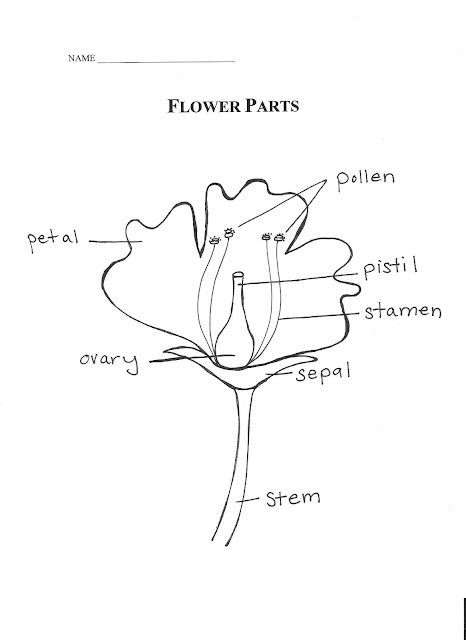
Who knows what dissection means? Dissection means to take something apart and look at the inside. Who wants to dissect a flower? (Have a diagram for each child that shows the different flower parts. Give each child a flower to dissect. Walk them through the different parts of the flower including the reproductive parts. Explain that pollen comes from the anthers, moves to the stigma, down the style, and into the ovary during pollination. A flower can pollinate itself, but many flowers require assistance from insects, wind, birds, or bats to move pollen from flower to flower which is called cross pollination).
Further discussion on pollination: What is pollination? Pollination is what happens when a flower turns into a seed, or a berry, or a fruit. The flower is beautiful and attractive and smells wonderful. Little insects come and get nectar from the flower. When they land on the flower, they get a little bit of pollen on them. Then they spread that pollen to the next flower they go to. That is exactly what the flower wants to have happen!!! Spreading pollen from one flower to the next is great!! Then the seed begins to grow.
Diagram of flower parts:
https://picasaweb.google.com/lh/photo/zFWLdGHD8kqRXYlKbOjN1dMTjNZETYmyPJy0liipFm0?feat=directlink
Game:
Pollination Game- have 6 cutouts of bees. Have 6 children be bees and the rest be flowers. Have the bees go from flower to flower and pollinate, until they have pollinated each. Then switch roles.
Song:
The Plant Part Song (Tune: The Farmer in the Dell)
The seed makes a plant.
With soil and rain and sunny days,
The seed makes a plant.
The roots find the water.
With soil and rain and sunny days,
The roots find the water.
The stem holds it up.
With soil and rain and sunny days,
The stem holds it up.
The leaves make the food.
With soil and rain and sunny days,
The leaves make the food.
The flower makes the fruit.
With soil and rain and sunny days,
The flower makes the fruit.
The fruit holds the seeds.
With soil and rain and sunny days,
The fruit holds the seeds.
Craft:
Handprint flowers- Give each child a piece of paper. Ask them to draw a stem and leaves. Paint each child’s hand with paint. Have them stamp their hand onto paper.
Sunday, April 1, 2012
Eggs and Nests
April 2, 2012
Nests and Eggs
Welcome song.
Today we are going to learn about nests and eggs! Our letter for today- E. Does anyone have a name that starts with e? Elliot, Eli, ….
Imagination exercise:
Before we go on our hike, I wanted to ask you all to close your eyes and imagine a little story with me. It’s a sunny, warm day in spring. You are outside playing and you see a really great climbing tree. It is tall and has branches down low so you can climb up onto them. You climb and climb. Pretty soon you are high in the tree. Then you see it! I wonderful little nest tucked near the trunk and a branch of the tree. It is about the size of your cereal bowl. You very carefully climb near it, careful not to bump the branches too much. Careful not to touch it. As you get closer, you peer inside. What do you see? Bright blue robin eggs! They look so fragile and delicate. They are the color of the sky. The nest has bits of feathers and straw and dried grass, cushioning the little eggs. You want to pick one up but you realize that there is a little baby bird growing inside the egg and you wouldn’t want to harm it. Plus, the mother or father robin will be back soon and they might be upset if you were touching their eggs! Carefully you climb back down the tree. You can’t wait to tell you family and friends about your discovery. As you gaze up into the tree again, you see a mother robin fly right into the tree and land on her nest!
Did you enjoy imagining that story? Should we go explore and see what we can find in the forest today?
Hike:
Allow the children to explore, look for nests, build a nest of their own with twigs, sticks, branches, etc. Point out various nest you see along the way.
Nest Matching Game:
Print out or find in magazines pictures of animals and their nests/eggs/dens/home (for example- alligator, turtle, swallow, salmon, snake, frog, robin, swan, chicken, beaver, squirrel, ant, snail, etc). We are going to play a game! Did you know that there are lots of different kinds of nest? I have a bunch of pictures of different nests with eggs inside. I want to see if you can tell me what kind of animal’s nest it is. Then, I’m going to pass out the animal and nest cards, and you are all going to try and find your match among your friends.
Egg in the middle game:
All the kids gather in a circle. The children in the circle make up the “nest”. One child sits in the middle, pretending to be an egg. They then hatch and act out an animal of their choice (the little ones may need help). The children making up the nest try and guess.
Books:
“Guess what is growing inside this egg” by Mia Posada
Water and Rain
*part of this lesson is a repeat of a previous lesson on water.
Nature School
March 26th, 2012
Water and Rain
Welcome song. Welcome new friends.
Today we are going to learn a little about water! We’ve talked about water before. Do you all remember? Why do you like water? (swim, drink, splash, bath, ocean, waterfalls, etc.). Do you know that we could not live on earth without water? What other creatures need water to live? Do plants need water too?
Explorations and Observation Time:
Encourage the kids to look our for animals and birds that live at the wetland, point out the beaver lodge, snags, nests, and wetland plants.
Did you know that the ground we are standing on is really a huge, gigantic sponge?! Alright, all the kids close their eyes. All the parents are going to jump one time on the count of three. One, two, three! Did the kids feel the ground move? That's because the soil here is saturated or filled with water.
Let’s think about the plants that live here. Do you see the trees that have their roots and trunks in the water? Most of these trees are willow trees. Willows like water. Can you say it with me? There are also lots of tall grasses like rushes, reeds, and cattails. These plants provide habitats, food, and security to the birds and animals that live here.
Song-
There is something we need to live and water is its name-o.
W-A-T-E-R, W-A-T-E-R, W-A-T-E-R, and water is its name-o.
Story- Drippy the raindrop
Once upon a time there was a raindrop named Drippy (picture of drop of water). Drippy was having fun! He was doing his favorite thing in the whole wide world- lying on his back floating in the ocean. He looked up at his good old friend Mr. Sun, who had just come up (hold up picture of sun). Mr. Sun rose higher and higher and Drippy got hotter and hotter!
Just then, Drippy saw a big, dark cloud moving across the sky. “I wish I could go up to that cool looking cloud and cool down a bit!”
All of a sudden, Drippy felt himself rising up into the air! He was evaporating! Can we all saw evaporate together? EVAPORATE!
He landed softly on a huge, fluffy cloud. There were thousands of other drops of water too. One of the drops of water called out to Drippy, “Ahoy there! I’m Salty!” (hold up picture of another drop of water with captain hat on).
“I’m Drippy! Nice to meet you. Where are we headed?”
“We are going right toward those mountains over there and it looks like a storm is a brewing. If things get rough, just abandon ship. Jump right off the cloud and toward the earth” Salty said.
After awhile, things did start getting rough. Drippy got ready to jump. 1-2-3-JUMP! Drippy was raining now! He fell with millions of other raindrops down toward the forest near the mountains.
Drippy landed right on a tree (show picture of tree with roots). He slid down on leaf onto a branch and then down the trunk. Down, down, down he slid down the trunk and into the soil near the tree’s roots. Wow! What an adventure we was having.
When we reached the soil, he found lots of other water drops there too. They were filling up the soil pores. He sunk deeper into the soil and into an underground stream. Then, guess what happened? The underwater stream came out of the ground as a spring!! The stream was now above ground. The stream eventually led him out into the ocean again!
Drippy leaned back, floating on his back and looked up at his good friend Mr. Sun again. “Hello there, Mr. Sun!” What an adventure I’ve had! I’ve been through the water cycle. Can you all say WATER CYCLE? I’m learned so much and seen so much of our beautiful earth. What a wonderful world we live in!”
Game: Find your partner puzzle. I found various pictures in national geographic of lakes, animals, insects, ocean life, etc. I laminated each picture then cut it in half. There are enough half pieces for each child to have one. Give each child a puzzle piece and ask them to find their partner with the other half.
Extra Parent Info:
Willows- 5 species that live here at Marsh Island. Native Americans used willow shoots for the same purpose we use asprin. Asprin was derived from willows-
Salmonberry and Thimbleberry- Native americans used these berries to make fruit leather
Nootka Rose hips- made into tea. Great source of Vitamin C
Bubbles in water- escaping methane gas from decaying plant material
A little history:
150-ft long Long house or potlatch houses- stood where UW steam smokestack and edgewater apartments. Where you see University Village, Ravenna Creek (now underground in the North Trunk Sewer) once emptied into the lake and was one of the highest salmon spawning creeks in the area.
The pathways- the city has built this path consisting of floating spans, bridges, viewing platforms which are anchored through the peat bog to the bedrock 80 feet below.
Animals:
Animals and birds to look for: great blue heron, eagles, buffleheads, coots, wood ducks, beavers, and western pond turtles.
Nature School
March 26th, 2012
Water and Rain
Welcome song. Welcome new friends.
Today we are going to learn a little about water! We’ve talked about water before. Do you all remember? Why do you like water? (swim, drink, splash, bath, ocean, waterfalls, etc.). Do you know that we could not live on earth without water? What other creatures need water to live? Do plants need water too?
Explorations and Observation Time:
Encourage the kids to look our for animals and birds that live at the wetland, point out the beaver lodge, snags, nests, and wetland plants.
Did you know that the ground we are standing on is really a huge, gigantic sponge?! Alright, all the kids close their eyes. All the parents are going to jump one time on the count of three. One, two, three! Did the kids feel the ground move? That's because the soil here is saturated or filled with water.
Let’s think about the plants that live here. Do you see the trees that have their roots and trunks in the water? Most of these trees are willow trees. Willows like water. Can you say it with me? There are also lots of tall grasses like rushes, reeds, and cattails. These plants provide habitats, food, and security to the birds and animals that live here.
Song-
There is something we need to live and water is its name-o.
W-A-T-E-R, W-A-T-E-R, W-A-T-E-R, and water is its name-o.
Story- Drippy the raindrop
Once upon a time there was a raindrop named Drippy (picture of drop of water). Drippy was having fun! He was doing his favorite thing in the whole wide world- lying on his back floating in the ocean. He looked up at his good old friend Mr. Sun, who had just come up (hold up picture of sun). Mr. Sun rose higher and higher and Drippy got hotter and hotter!
Just then, Drippy saw a big, dark cloud moving across the sky. “I wish I could go up to that cool looking cloud and cool down a bit!”
All of a sudden, Drippy felt himself rising up into the air! He was evaporating! Can we all saw evaporate together? EVAPORATE!
He landed softly on a huge, fluffy cloud. There were thousands of other drops of water too. One of the drops of water called out to Drippy, “Ahoy there! I’m Salty!” (hold up picture of another drop of water with captain hat on).
“I’m Drippy! Nice to meet you. Where are we headed?”
“We are going right toward those mountains over there and it looks like a storm is a brewing. If things get rough, just abandon ship. Jump right off the cloud and toward the earth” Salty said.
After awhile, things did start getting rough. Drippy got ready to jump. 1-2-3-JUMP! Drippy was raining now! He fell with millions of other raindrops down toward the forest near the mountains.
Drippy landed right on a tree (show picture of tree with roots). He slid down on leaf onto a branch and then down the trunk. Down, down, down he slid down the trunk and into the soil near the tree’s roots. Wow! What an adventure we was having.
When we reached the soil, he found lots of other water drops there too. They were filling up the soil pores. He sunk deeper into the soil and into an underground stream. Then, guess what happened? The underwater stream came out of the ground as a spring!! The stream was now above ground. The stream eventually led him out into the ocean again!
Drippy leaned back, floating on his back and looked up at his good friend Mr. Sun again. “Hello there, Mr. Sun!” What an adventure I’ve had! I’ve been through the water cycle. Can you all say WATER CYCLE? I’m learned so much and seen so much of our beautiful earth. What a wonderful world we live in!”
Game: Find your partner puzzle. I found various pictures in national geographic of lakes, animals, insects, ocean life, etc. I laminated each picture then cut it in half. There are enough half pieces for each child to have one. Give each child a puzzle piece and ask them to find their partner with the other half.
Extra Parent Info:
Willows- 5 species that live here at Marsh Island. Native Americans used willow shoots for the same purpose we use asprin. Asprin was derived from willows-
The leaves and bark of the willow tree have been mentioned in ancient texts from Assyria, Sumer and Egypt as a remedy for aches and fever, and the Ancient Greek physician Hippocrates wrote about its medicinal properties in the fifth century BC. Native Americans across the American continent relied on it as a staple of their medical treatments, because willows contain salicin, a substance that chemically resembles aspirin. It temporarily relieves headache, stomachache, and other body pain. Salicin is metabolized into salicylic acid in the human body, which is a precursor of aspirin. In 1763, its medicinal properties were observed by the Reverend Edward Stone in England. He notified the Royal Society, who published his findings. The active extract of the bark, called salicin, was isolated to its crystalline form in 1828 by Henri Leroux, a French pharmacist, and Raffaele Piria, an Italian chemist, who then succeeded in separating out the compound in its pure state. In 1897, Felix Hoffmann created a synthetically altered version of salicin (in his case derived from the Spiraea plant), which caused less digestive upset than pure salicylic acid. The new drug, formally acetylsalicylic acid, was named Aspirin by Hoffmann's employer Bayer AG. This gave rise to the hugely important class of drugs known as nonsteroidal anti-inflammatory drugs (NSAIDs).
(http://en.wikipedia.org/wiki/Willow)
Salmonberry and Thimbleberry- Native americans used these berries to make fruit leather
Nootka Rose hips- made into tea. Great source of Vitamin C
Bubbles in water- escaping methane gas from decaying plant material
A little history:
150-ft long Long house or potlatch houses- stood where UW steam smokestack and edgewater apartments. Where you see University Village, Ravenna Creek (now underground in the North Trunk Sewer) once emptied into the lake and was one of the highest salmon spawning creeks in the area.
The pathways- the city has built this path consisting of floating spans, bridges, viewing platforms which are anchored through the peat bog to the bedrock 80 feet below.
Animals:
Animals and birds to look for: great blue heron, eagles, buffleheads, coots, wood ducks, beavers, and western pond turtles.
Sunday, March 11, 2012
Lesson Plan- St. Patrick's Day
St. Patrick’s Day
Supplies: Popsicle sticks, markers, cotton balls, glue, Popsicle stick puzzles (rainbow, leprechaun, and pot of gold), treasure with coins, clues hidden in the forest, 5 paper shamrocks.
Welcome to nature school today!! We are going to have so much fun!
Let’s sing our welcome song to everyone-
Our letter of the day is “S” for St. Patrick’s Day, which is this week.
Game:
Let’s play a game called “Hiding the Shamrock”. I’m going to call on a child to be it. He or she will hide the shamrock while the rest of us close our eyes. When the child is done, I’ll say “shamrock” and everyone tries to find it. If you find it, you get to be the next to hide it and so on.
Hike:
Leprechaun treasure hunt:
Today I have a very special adventure for you. First, I have to tell you a little bit about leprechauns. Does anyone know what a leprechaun is? Leprechauns are little Irish fairies that look like little old men. They wear a red or green coat and they enjoy being a little bit mischievous. Leprechauns spend all their time busily making shoes, and store away all their coins in a hidden pot of gold at the end of the rainbow. If ever captured by a human, the leprechaun has the magical power to grant three wishes and they will tell you where their treasure of gold is, in exchange for their release.
Well, I was lucky enough to catch a leprechaun and talk to him. He told me that his treasure was hidden here in this forest! He gave me some clues. So we are going to work together to find his treasure today! We will all share the treasure once we find it. It won’t be easy. We will have to search deep in the forest to find it. Are you ready?
Clue #1:
Cross a bridge
Over the creek
On the other side
A clue you will seek
Clue #2
Use your legs
To climb up the hill
You’ll have to work hard
To find a clue still
Clue #3
Left or right
Which way to go?
Head uphill
where the tall trees grow
Clue #4
Here is a place
where the path splits in two
Look for my footprint
of a leprechaun shoe
Clue #5
You are getting closer
You are almost there
If you go downhill
You’ll not find it anywhere
Clue #6
Look near a tree
Around at the ground
Near the base of its trunk
My treasure will be found
Song:
FIVE LITTLE SHAMROCKS
Place 5 paper shamrocks on the felt board or on the floor.
5 little shamrocks growing outside my door,
(child's name) picked one, and then there were 4.
4 little shamrocks, green as green could be,
(child's name) picked one, and then there were 3.
3 little shamrocks, sitting by my shoe,
(child's name) picked one, and then there were 2.
2 little shamrocks, enjoying the sun,
(child's name) picked one and that left 1.
1 little shamrock for Saint Patrick's Day fun,
(child's name) picked it, and that left none.
(Author unknown)
Group activity/problem solving
Popsicle Stick Puzzles:
Make up three of four Popsicle stick puzzles ahead of time. I made one with a leprechaun, a pot of gold, and a rainbow. Ask the children to split into groups of three or four and solve the puzzles as they work as a team. Then have the groups swap puzzles, until the children have has the chance to do every puzzle.
Game:
Who’s Sitting on Gold…
A gold coin- chocolate foil covered, plastic, or a quarter wrapped in foil. Have the children sit on the ground in a circle or line. One child is designated as the leprechaun. Ask him/her to sit with back facing the children and gold coin sitting on the ground behind him/her. Signal for one child to run and pick up the gold coin and sit on it. Then have the children say:
“Leprechaun, leprechaun where is your gold.
Someone stole it from your home”
The leprechaun has three guess to reveal the child. The child who stole the gold than becomes the leprechaun.
Craft:
Popsicle stick rainbows. Give each child a popsicle stick and markers. Let them color a rainbow on it, you can tell the the color order or just let them be creative. I made an example ahead of time but I’ll encourage them to color theirs whatever way they would like. At the end of each popsicle stick, glue on two cotton balls.
Subscribe to:
Posts (Atom)